Ghosts Were Dancing Too
Nick Cave returns to the city that shaped him, with The Bad Seeds, Kylie Minogue and forty years of ghosts to Preston Park, for a night, a place where the absent and the present could dance together.
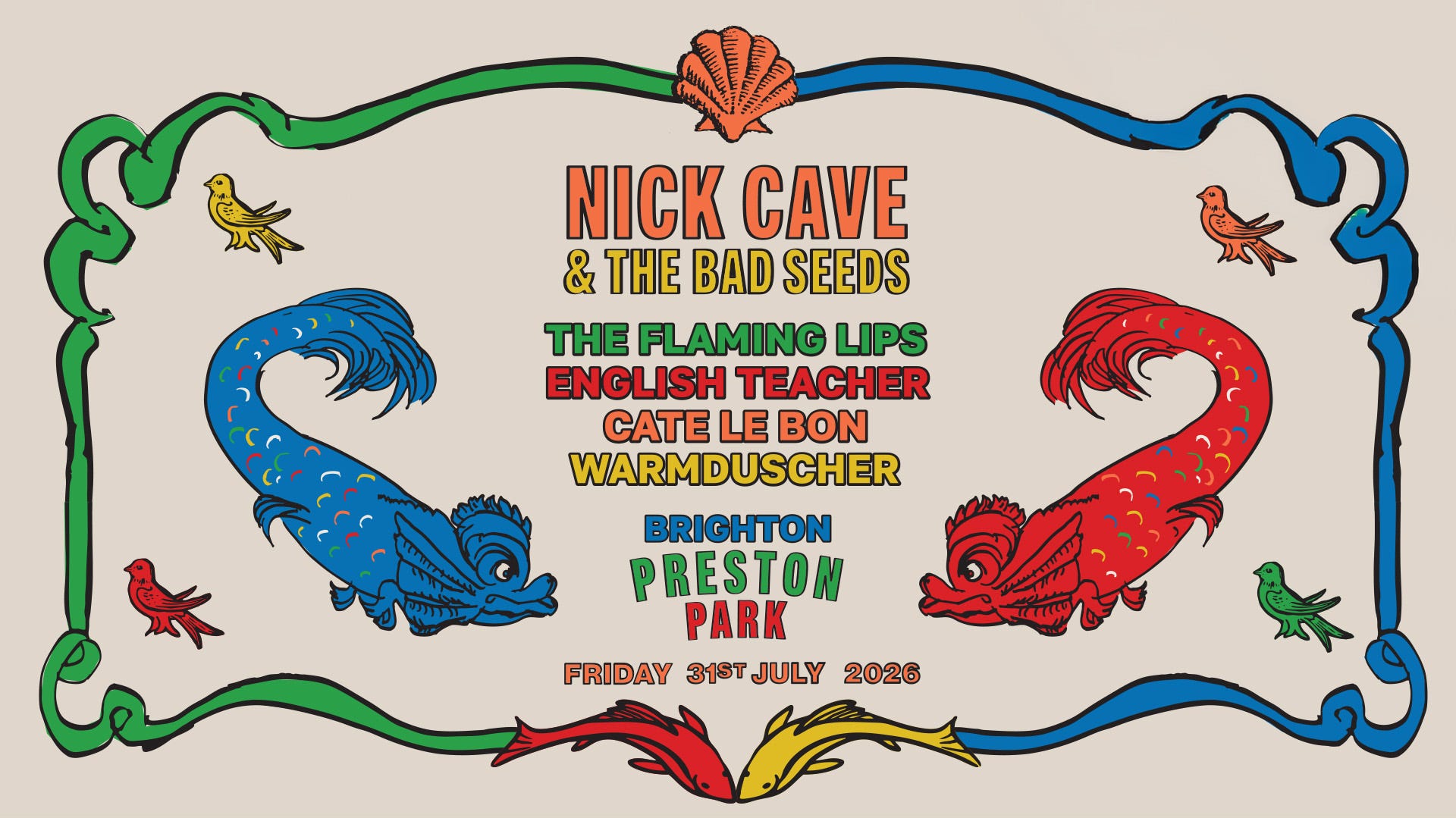
Five o'clock, and Brighton's cooking. Heat's wedged itself between the buildings like it's paying rent there. Tarmac gone soft and sticky, the whole place reeking of hot pavement, spilled lager and someone else's sun cream. Every street funnelling up towards Preston Park is rammed with people in black. Bad Seeds shirts that have survived divorces, house moves, breakdowns and, at least, one criminal haircut. Kids who weren't even a rumour when The Boatman's Call came out, walking next to blokes in their sixties who look like they never quite left 1989 and stopped bothering to try.
You don't need directions. Just follow the trains dumping bodies into the city, the buses stuffed to the doors, the pubs behaving like they'd had six months' notice that fifty thousand thirsty people were about to descend on them. People who know full well they're about to stand in a field for hours, deciding this is still the perfect moment for one more pint. Because obviously it is.
Brighton's turned the whole thing into a civic holiday, and fair enough. Cave isn't just passing through. Lived here the best part of twenty years, long enough that the city got welded into his private mythology, the place where certain songs took shape and never quite let go of him even after he did. This is Jubilee Street territory, The Death of Bunny Munro, 20,000 Days on Earth. Sea air, brutal winters, odd little backstreets, the years before everything changed how he saw the world.
But it's also a city that kept going without him. That's just what cities do. Shops opened, shops shut, ugly buildings went up, people fell in and out of love, got wrecked, moved away, came back, ran Pride, carried on telling stories about whoever used to live round here.
Funny thing is, he's already come home before the gig's even started. Resident Records had been mid-takeover since the 30th, and word had been going round for days that the band might show up on the roof. By quarter to eleven that morning the street outside was already heaving. At eleven, there they were: Train Long-Suffering to open, then a loose, piano-led run through T. Rex's Cosmic Dancer with Warren Ellis peeling off a violin solo, then Henry Lee with Janet Ramus stepping into PJ Harvey's old part, and an encore of Papa Won't Leave You, Henry to send everyone off buzzing. Susie and Earl watched from the edge of the balcony. "Fucking Brighton," Cave told the street below. "What a thing to be doing." Four songs, twenty-odd minutes, gone, and somehow it still made the Guardian by lunchtime.
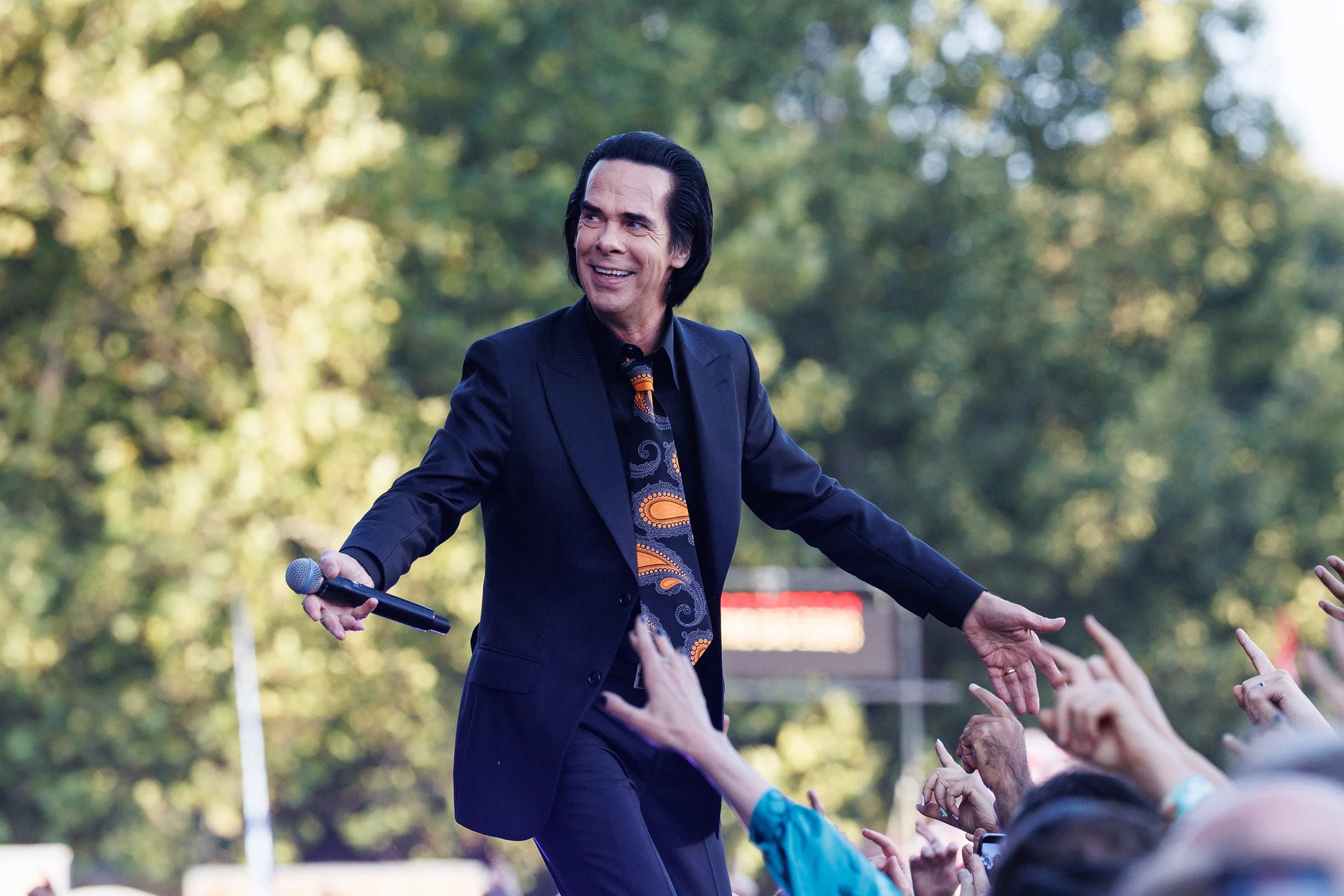
A few hours later, same story, different scale entirely. A field. Fifty thousand people, give or take (reports land anywhere from forty-six to fifty). A stage the size of a building. And Nick Cave walking out around half seven, dressed in black, looking like a preacher who's wandered into the wrong gig and decided to run with it anyway.
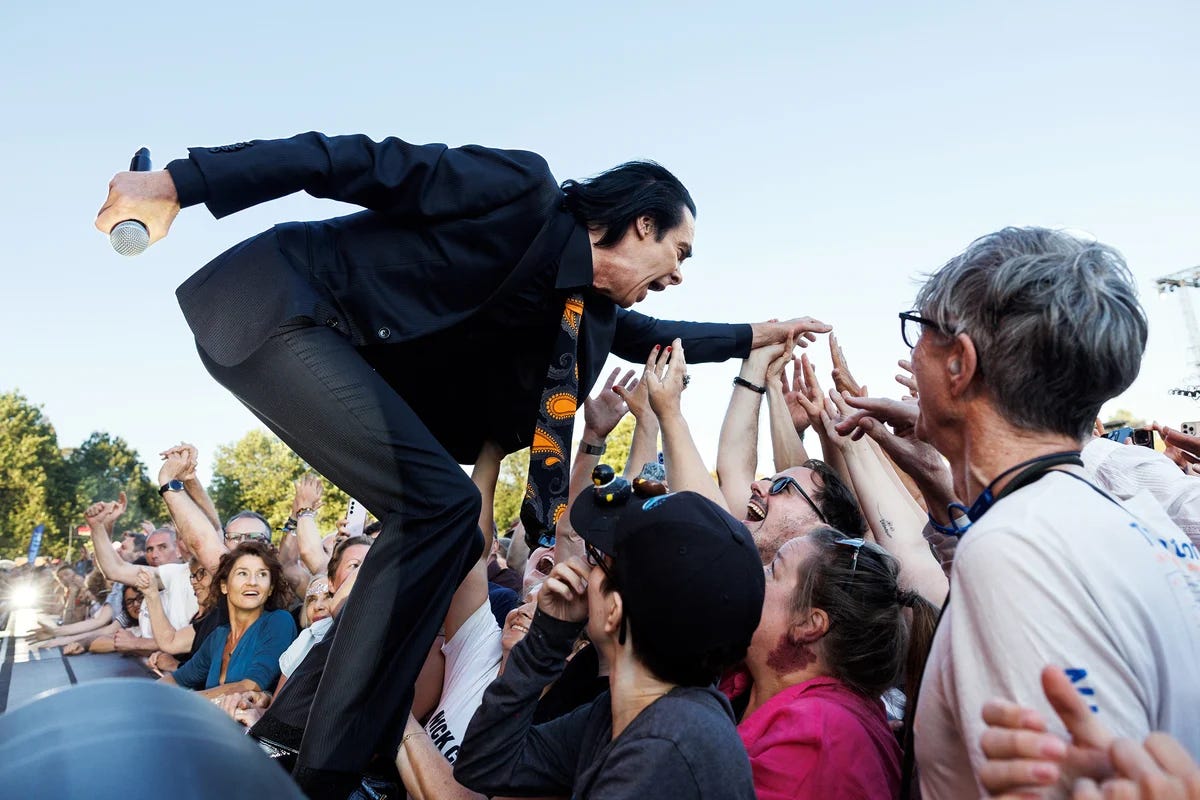
Get Ready for Love kicks the night open and there's no easing in. Cave's straight off the stage and into the crowd, reaching for hands, hunting faces. By the time the song's over he's visibly choked up, tells the crowd, more or less, that being back here has completely wrecked him. Everyone believes it. You can see it doing the rounds through the front rows like a current.
The first thing that actually gets you isn't the size of the production. It's how much history he's dragged up there with him. From Her to Eternity lands early and it's like someone's kicked a door open onto another decade: the feral, near-animal Cave of the early years, the preacher, the bastard who looks like he crawled out of some Australian swamp specifically to tell the rest of us rock'n'roll can be a form of possession too. Next to him, Ellis does the Ellis thing, dragging a violin somewhere it's got no business being.
The great thing about the Bad Seeds is they don't sound like a band that's stuck together for forty years out of habit. They sound like a band that's spent forty years fighting, falling apart and rebuilding itself, over and over, which is a completely different animal. Train Long-Suffering comes round again and the day folds in on itself. Same song, roof of a record shop a few hours back, now tearing across a field of fifty thousand. 1985 and 2026 end up in the same room, even if that room's a park and the roof's the Brighton sky.
Wild God and O Children keep the engine running, less the songs you'll be talking about tomorrow than the ones doing the actual work: backing singers thickening everything up, the crowd finding its feet.
Then Tupelo lands and the whole temperature shifts. Larry Mullins and Jim Sclavunos throw up a wall of drums while Ellis drags his violin into the storm of it, and Cave tells the story of Elvis being born like something biblical's still got a shot at happening out there past the edge of the park. This is one of the things the Bad Seeds have always done better than nearly anyone: take a forty-year-old song and make it sound freshly assembled tonight, on the spot, out of spare parts and nerve.
Carnage drops the volume without dropping the band. Cave introduces it with a dig at himself, some line about him and Ellis once trying to be Simon and Garfunkel, him playing Garfunkel to Ellis's tunesmith. The crowd laughs, Ellis looks faintly embarrassed, and then it plays out as a held breath before Joy, and suddenly that title on its own feels almost cheeky. Joy. A word that, coming out of Nick Cave after everything, seems nearly too big to say without wincing. Happiness is a different animal altogether, easier, smaller. What he seems to be reaching for is the idea that joy can sit in the same room as grief without either one having to leave, that losing something doesn't mean you bolt every window shut for good.
Rings of Saturn comes next, delivered from the piano stool with George Vjestica on acoustic guitar, before Cave gets up and heads straight back to where he spends most of the night: right up against the crowd.
Then Cave stops dead and looks off to the side of the stage.
“Can we please welcome to the stage, Kylie Minogue!”
Nobody reacts for a second, fifty thousand brains all trying to confirm this is actually happening. Then there she is: white dress by Susie Cave, walking out like she's just stepped off a different decade entirely. It's the first time they've done Where the Wild Roses Grow with the Bad Seeds since 2018, and for anyone who grew up in the nineties, that's basically what it feels like: a decade climbing back out of the ground. "I am so happy to be here, always," she tells him, before something about undying love that gets the whole field making a noise like a kettle going off.
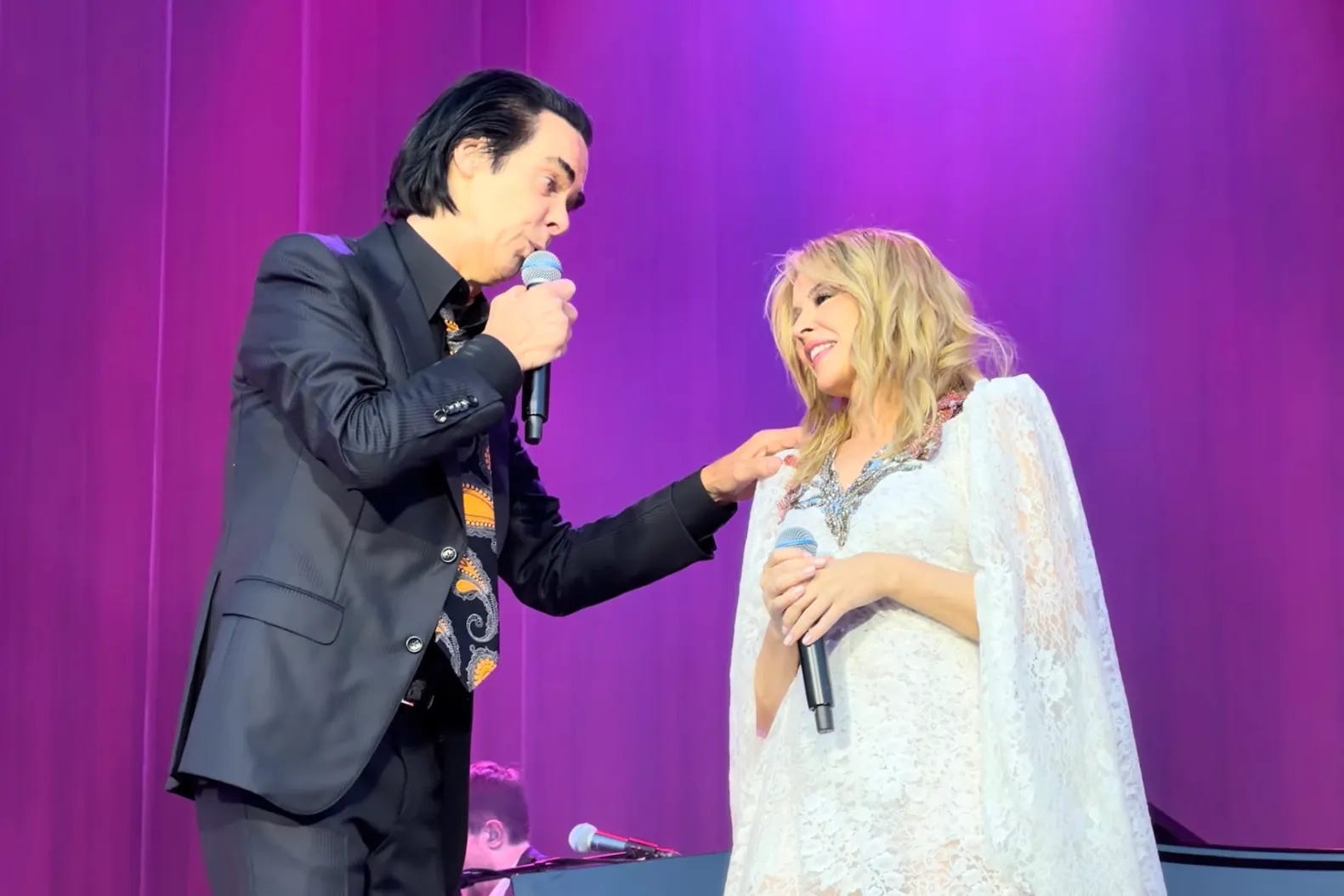
We all know the story: the video, the murder ballad, how it ends. But music's got this annoying habit of holding onto things better than we manage to ourselves. A song can sit quiet in a corner for thirty years asking nothing of you, then one summer night decide it's time to remind you exactly who you were the first time you heard it. Cave and Kylie sing at each other, then hold on tight. It isn't just nostalgia. It's stranger than that. Two people singing words written when they were both a lot younger, before every loss and every rewrite that quietly changed what those words actually meant. Kylie goes. The song ends. The past doesn't leave with her.
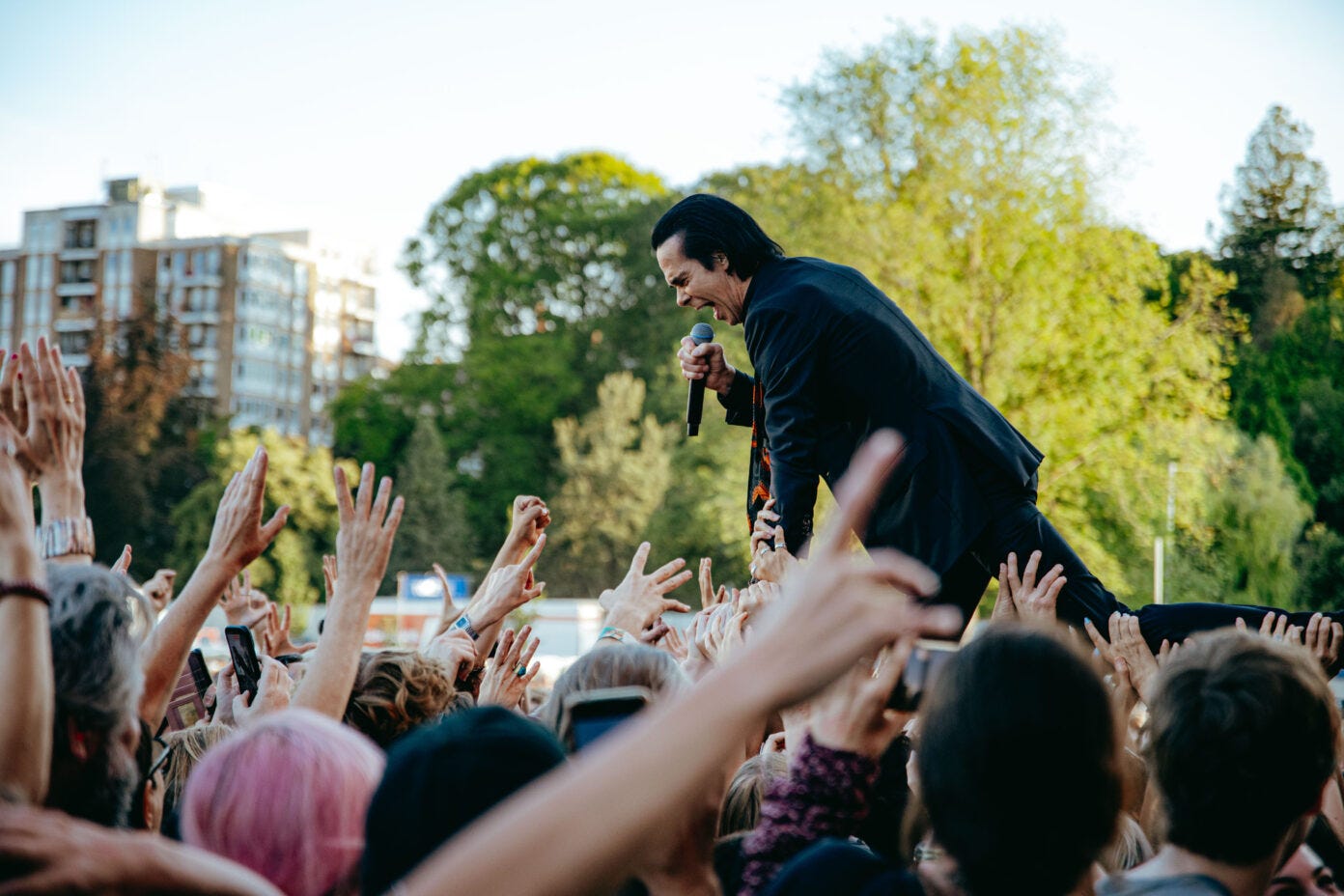
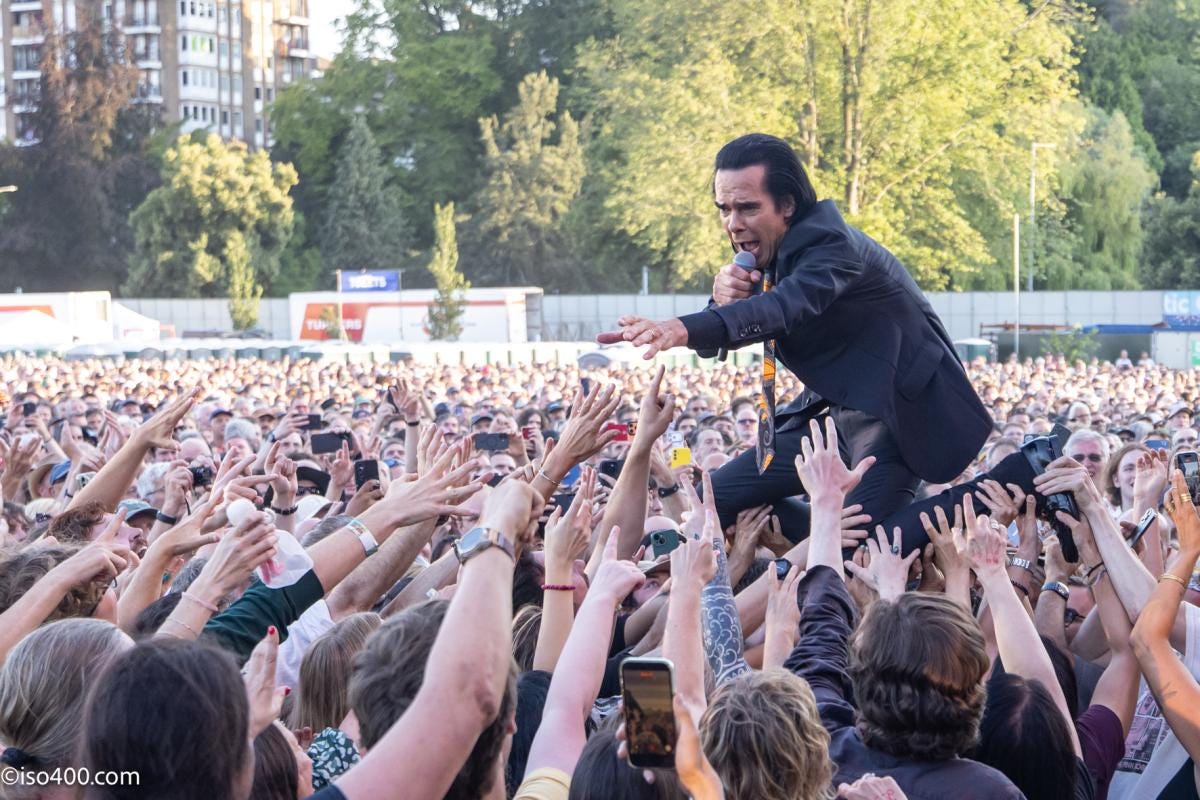
Back to work. The Mercy Seat is a full-on ambush. Papa Won't Leave You, Henry drags the old Cave back into the room, the one who can turn a song into a travelling house fire, and at some point in it he ends up hoisted onto the crowd's shoulders, riding the front rows like a man who's forgotten he's sixty-eight. Red Right Hand does what Red Right Hand always does: grabs you by the collar and hauls you into the dark.
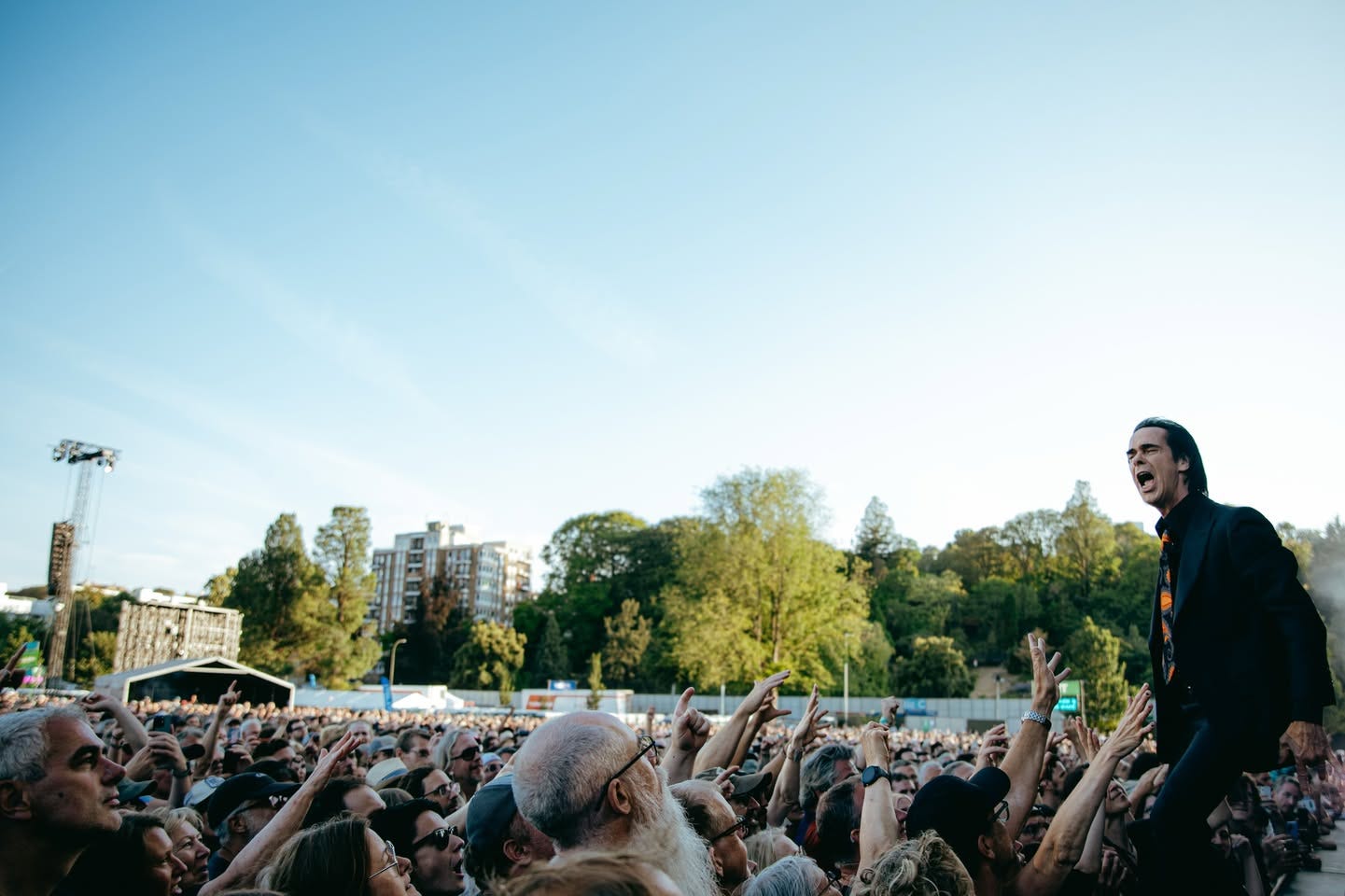
Cave stays right on the edge of the stage through most of it. He's not singing to fifty thousand people, he's singing to fifty thousand people one at a time, chasing individual faces out of the mass. At one point he tells someone in the front row, "I'm a reflection of your beauty," a line that should get laughed straight off the stage and somehow, from him, just doesn't. That's the whole deal he's built with an audience over the decades, a straight trade. They give him their attention. For a couple of hours he hands back the feeling that they're actually part of the story.
The Weeping Song comes next, and Cave warns the crowd, half-joking, that this is the one where you cry, before promising they won't be at it too long. He claps out the rhythm himself and gets the whole field clapping along with him, the sound landing somewhere between percussion and rain.
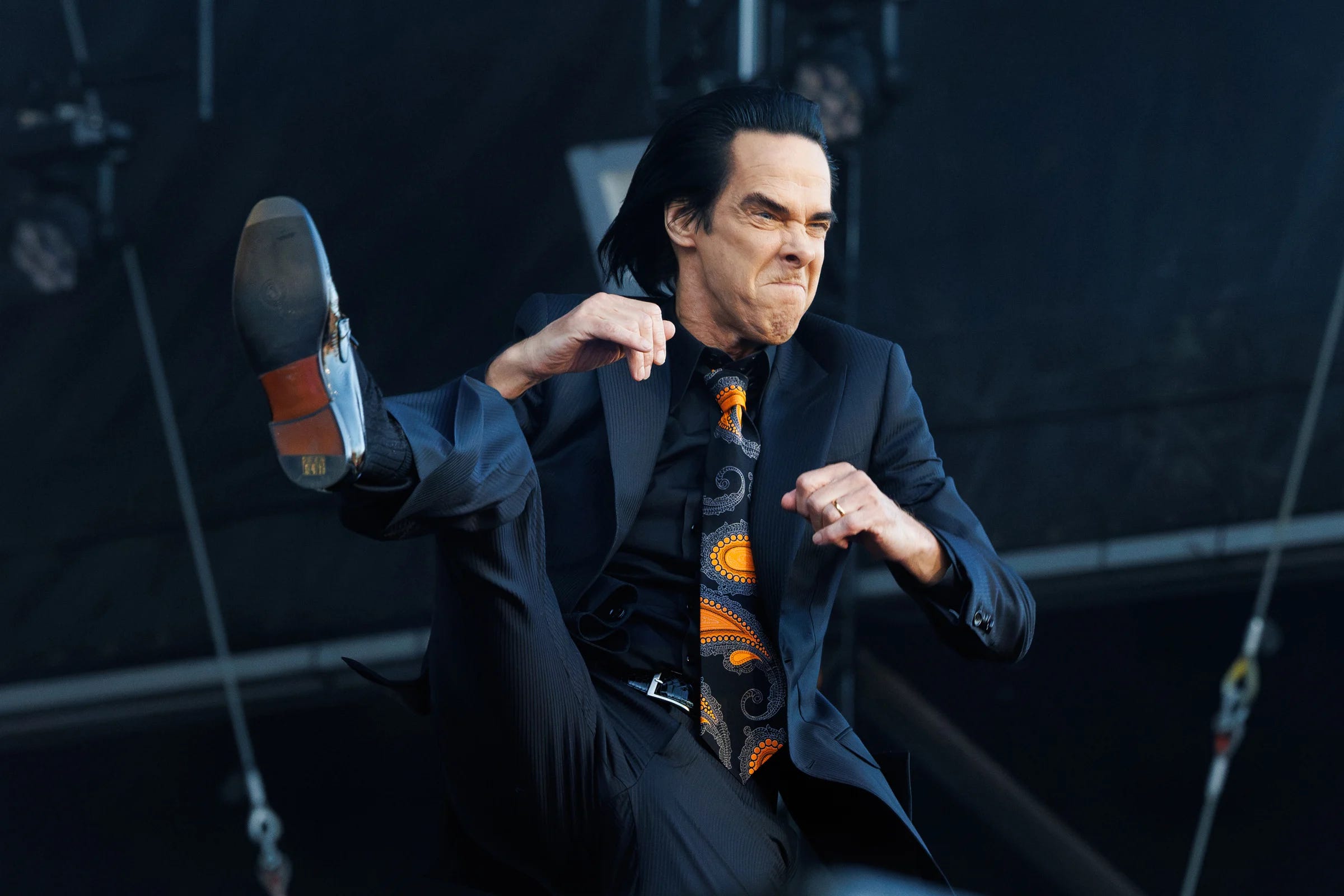
Then Jubilee Street arrives, and something properly strange kicks in: Brighton stops being the backdrop and turns into the main character, the scruffier, more ordinary version Cave's spent decades turning into his own private mythology rather than the postcard one people come down for on a weekend. The streets and the pubs and the people wandering through them with no idea they've ended up inside somebody's song. The track builds slow, then speeds up, swells, catches fire properly. Ellis shoves it forward, the drums turn industrial, Cave keeps repeating the words till the crowd's throwing them straight back and you genuinely can't separate the voice on stage from the ones underneath it. Fifty thousand people, one voice.
This is what the Bad Seeds actually are, live: an organism, not a machine, one that knows exactly when precision needs binning. Tight and completely feral at once, controlled and out of control in the same breath, capable of swinging from the ugliest noise to the most fragile whisper without any of it looking out of place.
After Hollywood the band vanish and the stage suddenly looks massive and a bit stupid, all that gear, lights, cable, scaffolding, sitting there for one man. There's a proper break, then they're back for the encore: harmonica first, wailing straight into City of Refuge. Then Cave dedicates the next one to Susie, tells the crowd it's actually about Brighton and the beach, not the nudist end, he clarifies, while a photo of the old West Pier's blackened skeleton gets thrown up on the screen behind him for Wide Lovely Eyes. Then the band's thanked, and gone, and it's just Cave, alone, at the piano.
Into My Arms.
This is where the whole night finally clicks, not because it's the most famous song or the easy option for a closer, but because it's where every thread of the evening meets: faith and doubt, love and loss, the people still here and the ones who can't be. The crowd sings it. He leaves the space for them to. For a second Preston Park stops being a field with a gig stuck in it and turns into one of those impossible rooms that's had way too many people crammed inside, and somehow nobody's out of place.
And without meaning to, you start thinking about who's missing. The people who couldn't make it. The people who'd have wanted to be there. Old Bad Seeds, old mates, people Cave's lost along the way, earlier versions of him, and, inevitably, earlier versions of yourself. This is what music does when it's actually working: it makes the dead awkwardly, inconveniently present. Lets them sit next to the living for four minutes, and nobody's got the nerve to tell them to leave.
The song ends. Cave thanks Brighton, "God bless, good night," and he's gone.
Two and a quarter hours of music. Forty years of songs. A morning on a rooftop, Kylie Minogue, fifty thousand people, and a city that behaved for one day like Nick Cave never actually left it.
Outside the park the magic comes apart fast. Fifty thousand people go back to being fifty thousand separate people, couples hunting for each other, mates arguing over the best song, someone after a bus, a smoke, a phone, a toilet. Someone's lost a phone. Someone's found one. Someone's still crying. Someone else is laughing. Brighton takes the whole lot back, no questions asked.
Next morning, while they're taking the stage apart and the city gears up for Pride, Cave's down on the seafront promenade, knackered, barely slept, just out of a dawn swim in water that by his own account is properly cold. Around him Brighton's already resetting itself: parade floats lined up along the front, someone flogging novelty hats of dubious taste, a girl dressed as a slice of watermelon working on a placard about homophobia, a jogger with a huge white dog who clocks him, stops, and just hugs him. He'd been at the show the night before.
No stage anymore. No lights. No fifty thousand people. Just Brighton, the ordinary one, the one that gets up, walks the dog, buys a coffee, has an argument with someone, gets ready for Pride, looks out at the sea and carries on.
His manager rings that morning with the numbers: biggest ticketed show Brighton's ever hosted, by some distance. Cave, writing it up himself a few hours later, sounding as knackered as he clearly was, calls the whole thing "so completely and emotionally overwhelming," and says the whole point, in the end, was managing for one delirious stretch of time to build somewhere the absent and the present could actually dance together.
Coming home was never really about going back to the place you left. It's finding out the place had been quietly holding onto a piece of you the whole time, without ever once mentioning it.
Nick Cave came home to Brighton, and Brighton remembered him. Maybe it remembered something else too, who he used to be, before all of it. Because that’s the thing cities do with their ghosts. Let them go, sure. Never quite let them leave.
And that night, at Preston Park, the ghosts weren’t just watching.
They were dancing too.
Setlist
Nick Cave & The Bad Seeds, Preston Park, Brighton, 31 July 2026
Get Ready for Love
From Her to Eternity
Train Long-Suffering
Wild God
O Children
Tupelo
Carnage
Joy
Rings of Saturn
Where the Wild Roses Grow (with Kylie Minogue)
The Mercy Seat
Papa Won’t Leave You, Henry
Red Right Hand
The Weeping Song
Jubilee Street
Hollywood
City of Refuge
Wide Lovely Eyes
Into My Arms
Nick Cave & The Bad Seeds, Live Line-up
Nick Cave: vocals, piano
Warren Ellis: violin, guitars, keyboards, mandolin and other instruments
Colin Greenwood: bass
Jim Sclavunos: drums, percussion
George Vjestica: guitar, backing vocals
Larry Mullins: drums, percussion, backing vocals
Carly Paradis: keyboards
Janet Ramus: backing vocals
T Jae Cole: backing vocals
Mića Townsend: backing vocals
Wendi Rose: backing vocals